Longevity science is moving beyond the idea of a simple “anti-ageing pill.” The conversation is now shifting towards something more practical: how to support the body’s energy systems in a more informed and targeted way.
At the centre of that conversation is NAD+, a coenzyme found in every living cell that plays a role in how the body produces energy. NAD+ has long been recognised as essential for life, but the focus is now evolving. Instead of simply observing that NAD+ levels decline with age, the question has become whether they can be supported more precisely through compounds such as NMN.
For many people, the goal is not just living longer, but helping the body maintain resilience and function well over time.
NMN vs NAD+: What is the difference?
One of the most common questions is the difference between NMN and NAD+.
NAD+ is the active coenzyme. It plays a role in how the body produces energy, supports DNA repair, and is involved in how cells communicate with each other. But NAD+ itself is a relatively large molecule, which means it does not move into cells very easily.
NMN, by contrast, is a precursor to NAD+. In simple terms, it is a building block the body can use to make NAD+. Because it is smaller, it is more easily absorbed and then converted into NAD+ inside the cell.
For this reason, NMN is often viewed as a more efficient way to support NAD+ levels.
Why NAD+ has become so important
NAD+ has attracted attention because it plays an essential role in two important cellular processes: energy metabolism, which is how cells convert nutrients into usable energy, and DNA repair, which helps cells respond to and repair everyday damage over time.
Mitochondrial health
Mitochondria are often described as the power plants of the cell. They help convert nutrients into energy that the body can use. NAD+ is a key part of this process. As NAD+ levels decline with age, mitochondrial efficiency may also decline, which can affect how well the body produces and uses energy, as well as physical endurance.
DNA repair
Every day, DNA is exposed to stressors that can cause small errors or damage. The body has natural repair systems to help fix this. These repair processes depend on NAD+ to function. Supporting NAD+ levels may therefore help the body maintain these natural repair processes.
Why testing comes before supplementation
In a crowded supplement market, NMN is often presented as a general wellness product. In this article, however, it is framed as something that should be used more selectively, with a clearer understanding of what is happening in the body.
The basic principle is simple: measure first, then decide. Rather than assuming everyone needs NMN, the approach described here is to look at a person’s broader biological picture first. That can include biological age testing, inflammation clocks, and metabolic panels. The aim is to build a broader picture of how the body is functioning and whether the data suggests metabolic stress or patterns associated with faster biological ageing before introducing NMN as part of a wider plan.
The idea is not simply to take NMN because it is popular, but to use it when the data suggests it may fit the situation, at the right dose, and with monitoring over time.
Dosage, timing, and safety
How NMN is used matters.
Clinical research cited here suggests that 250 mg to 900 mg per day may be effective for boosting NAD+ levels, while doses up to 1,200 mg have been shown to be safe. At the same time, the point is made that more is not always better. The goal is to support a steady biological state rather than simply taking the highest dose possible.
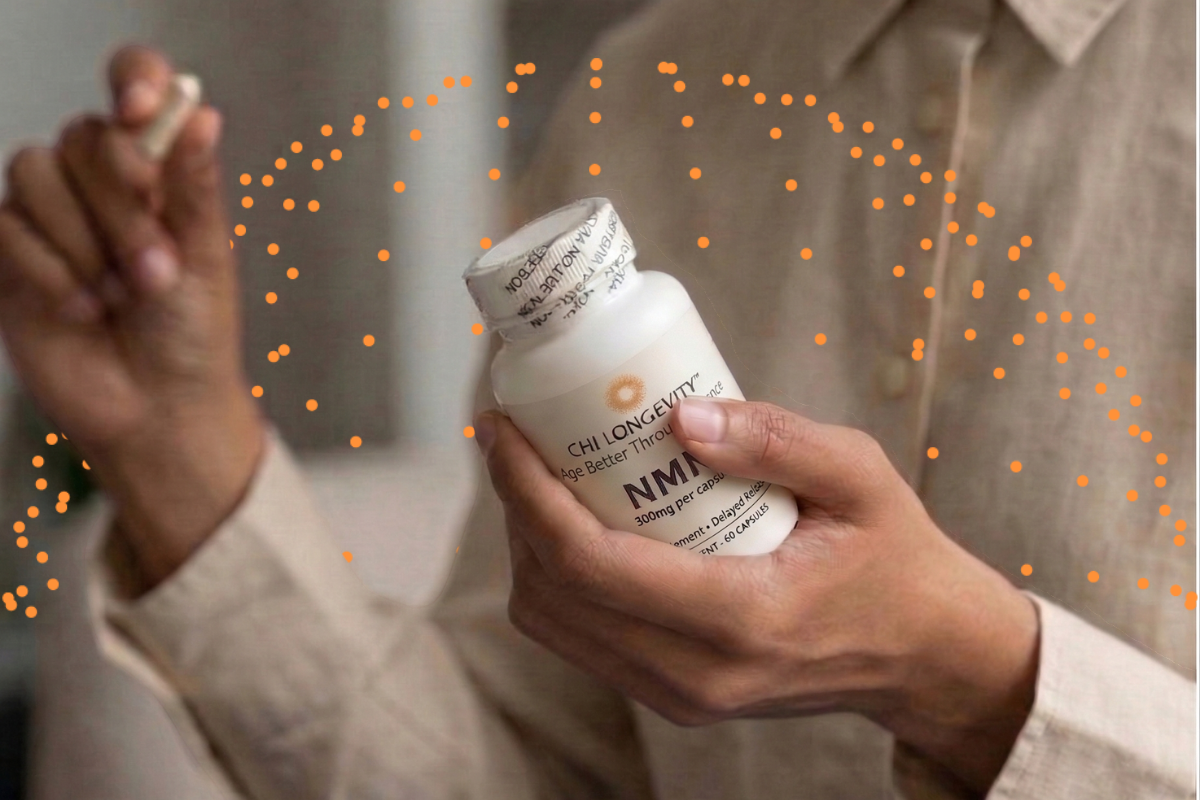
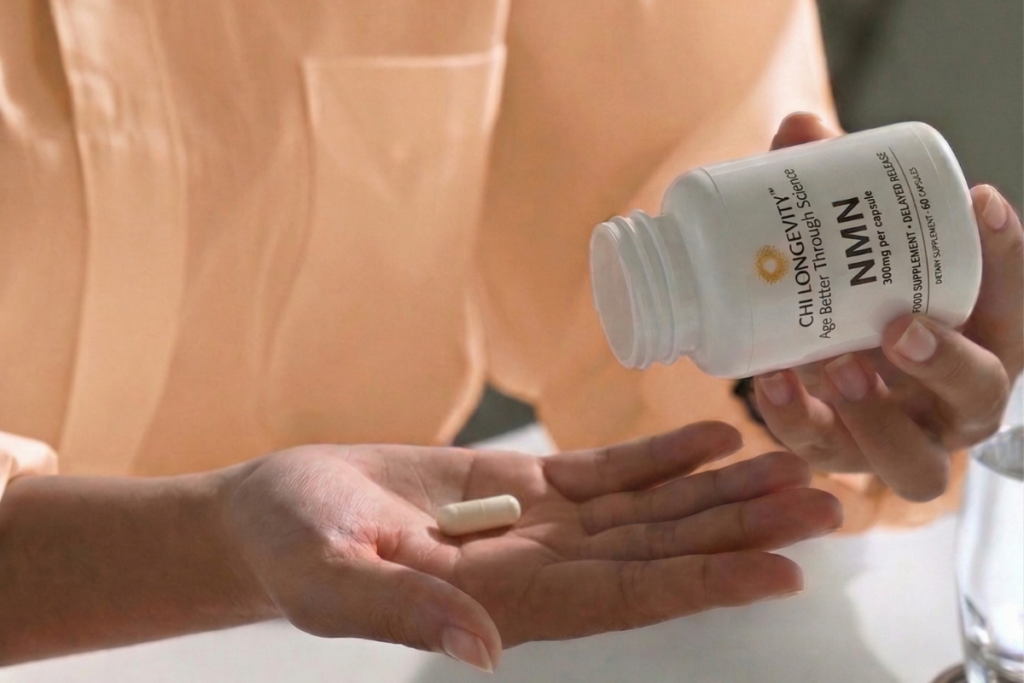
At Chi Longevity, the NMN supplement is provided in a 300 mg dose. Because each person is treated as an individual, supplementation is considered on a case-by-case basis. Your NAD+ results help guide whether NMN is appropriate, how much to take, when to take it, and for how long. The team then uses that information to personalise the plan and refine it where needed over time.
In terms of timing, many people take NMN in the morning, in line with the body’s natural circadian rhythm for NAD+. This is intended to support energy when mental and physical demands are often highest.
The piece also notes that NMN is generally well tolerated, but because it affects cell metabolism, professional oversight is still important, especially for people with pre-existing conditions or higher metabolic risk.
Some users report noticing gradual improvements in mental clarity, concentration, and physical resilience within two to three weeks, although NMN is not described as a stimulant.
Quality matters
Supplement quality is important.
A study linked with NUS Medicine is cited as showing that some anti-ageing supplements on the market do not contain the amount of active ingredient stated on the label. In other words, product quality and accuracy may vary considerably.
That matters because the value of a supplement is not only about the ingredient itself, but also about whether the product actually contains what it claims to contain.
The bigger picture
Ultimately, this piece frames NAD+ support as something bigger than “anti-ageing.” The focus is on maintaining physical resilience and cognitive sharpness over time, and on using biological data to guide decisions more precisely.
The overall strategy described is:
- Assess and evaluate by building a biological baseline
- Integrate and implement NMN as a targeted tool within a broader plan
- Optimise and reassess by monitoring markers and adjusting over time
The core message is that cellular energy should be treated as something worth understanding and managing carefully, not something to approach through guesswork alone.
The Chi Longevity approach
Chi Longevity offers NMN within its programmes because supplementation is most meaningful when it sits inside a wider evidence-led plan. Rather than treating NMN as a generic product, the focus is on understanding the baseline first, defining the goal clearly, and reassessing over time. This allows supplementation, where appropriate, to be used with more precision and context as part of a broader healthy longevity strategy.
Explore the Chi Longevity NMN supplement →
References
- Yi, L., Maier, A. B., Tao, R., Lin, Z., Vaidya, A., Pendse, S., Thasma, S., Andhalkar, N., Avhad, G., & Kumbhar, V. (2023). The efficacy and safety of β-nicotinamide mononucleotide (NMN) supplementation in healthy middle-aged adults: a randomized, multicenter, double-blind, placebo-controlled, parallel-group, dose-dependent clinical trial. GeroScience, 45(1), 29–43. https://doi.org/10.1007/s11357-022-00705-1
- Huang, P., Jiang, A., Wang, X., Zhou, Y., Tang, W., Ren, C., Qian, X., Zhou, Z., & Gong, A. (2021). NMN Maintains Intestinal Homeostasis by Regulating the Gut Microbiota. Frontiers in nutrition, 8, 714604. https://doi.org/10.3389/fnut.2021.714604
- Sandalova, E., Li, H., Guan, L. et al. Testing the amount of nicotinamide mononucleotide and urolithin A as compared to the label claim. GeroScience 46, 5075–5083 (2024). https://doi.org/10.1007/s11357-024-01257-2